
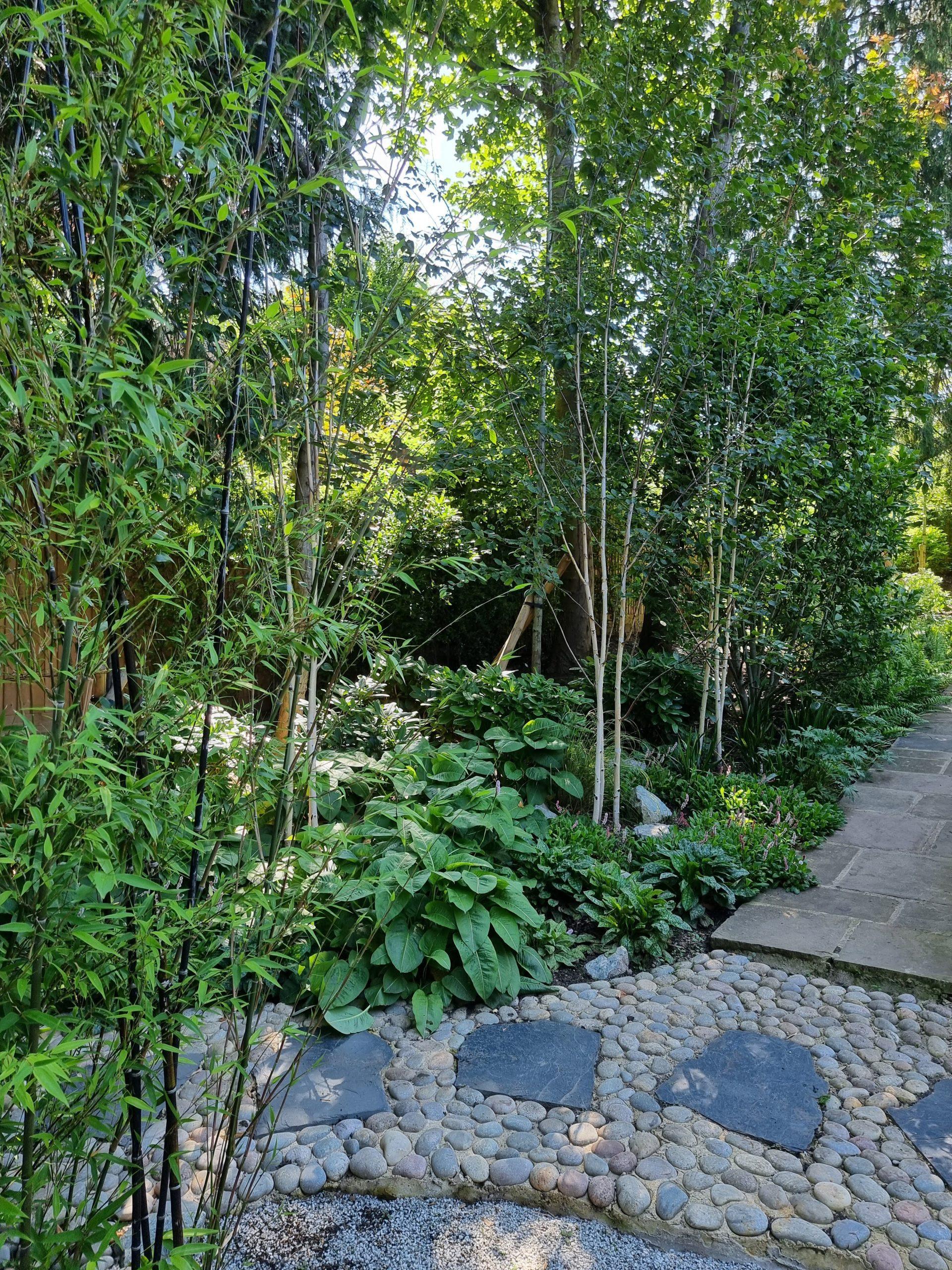
Planting like a designer: the 70/30 rule applied to London courtyards and terraces
Courtyard composure: how to plan a refined small garden that feels spacious
Autumn is the planting designer’s season. Soil is still warm, rain returns and roots establish quietly while the city slows down. For compact London courtyards and roof terraces, this is the moment to set structure, texture and scent in place so spring emerges composed rather than hurried.
This guide shows how to plant like a designer using the 70/30 rule, with practical detail on aspect-led choices, container depths for roof gardens, discreet irrigation and micro-site strategy. It includes grouped plant examples you can lift straight into a London courtyard, basement or sunny terrace, timed for September to November installations.
What the 70/30 planting rule means
The 70/30 rule keeps small spaces calm, legible and low maintenance. Roughly 70 percent of planting is structural and repeated, creating rhythm through evergreen forms, grasses and reliable perennials. The remaining 30 percent delivers seasonal colour and scent through bulbs, flowering perennials and accent shrubs. Structure holds the garden together in winter and on quiet days; accents lift mood when you want flourish.
Think of the 70 percent as the bones, and the 30 percent as the jewellery. In practice, that means repeating a short list of evergreens and grasses around the space, then weaving in bulbs and a few seasonal performers rather than filling every pocket with different plants.
How to design a planting scheme for small London spaces
Start with one governing idea. In a courtyard or terrace, repetition and restraint do the visual heavy lifting.
- Map aspect, wind and views. Note shade pockets beside boundaries and sun on upper terraces. In basements, treat light as a material and use pale surfaces to reflect it.
- Choose the 70 percent first. Pick 5 to 7 structural species you can repeat. Keep leaf texture and form varied but palettes tight.
- Add the 30 percent for colour and scent. Select bulbs and a few perennials or scented shrubs that flower across spring to autumn.
- Place fragrance where it matters. Night-scented species near doors and seating make evening terraces feel generous.
- Confirm buildability. Resolve planter sizes, depths, drainage and discreet irrigation before ordering plants.
If you are planning a broader refresh that also resolves paving, edges and levels, explore garden planning as a structured way to align circulation, materials and planting in one composition.
Micro-site essentials for courtyards and roof terraces
Small London sites succeed when technical details are resolved early.
- Wind mapping and shelter: On exposed terraces, anchor taller planting behind balustrades or screens and step heights down toward seating. In courtyards, watch for downdrafts from upper floors.
- Loading and planter specification: Confirm load capacity with an engineer for roof gardens. Powder-coated metal planters with internal insulation and drainage layers perform well.
- Container depth guidance: As a rule, 300 to 350 mm for low grasses and groundcovers, 400 to 450 mm for medium shrubs and mixed perennials, 500 to 600 mm for multi-stems and small trees. Depths can vary by species; err deeper for resilience.
- Discreet irrigation: Run a timed dripline with pressure regulation and flush points, concealed behind planters or along boundaries. This protects consistency and reduces maintenance.
- Drainage and cleanliness: Use free-draining substrates in containers with filter geotextile above the drainage layer. Keep outlets accessible.
For terraces where hard landscaping will be renewed, see ideas that connect planting with paving and layout in patio design.
Aspect-led plant selection
Shaded basements and north-facing courtyards
- Structure, repeated: Trachelospermum jasminoides (for evergreen climber and summer scent), Fatsia japonica, Asplenium scolopendrium, Dryopteris affinis, Sarcococca confusa near doors.
- Texture and movement: Hakonechloa macra in brighter shade, Luzula nivea, Polypodiums.
- Seasonal accents: Helleborus orientalis hybrids, snowdrops and Narcissus ‘Thalia’ for spring light, Anemone x hybrida for late summer to autumn.
Sunny terraces and south or west aspects
- Structure, repeated: Pittosporum tenuifolium ‘Golf Ball’ or ‘Tom Thumb’, Eugenia or Myrtus communis for clipped form, multi-stem Amelanchier lamarckii or Olea europaea in suitable microclimates.
- Grasses and rhythm: Stipa tenuissima, Pennisetum alopecuroides ‘Hameln’, Sesleria autumnalis for cool green in heat.
- Seasonal accents: Salvia nemorosa ‘Caradonna’, Nepeta ‘Walkers Low’, Verbena bonariensis, tulips in restrained colour families.
Wind-prone roof gardens
- Structure, repeated: Osmanthus x burkwoodii, Elaeagnus x ebbingei, Phillyrea latifolia for salt and wind tolerance.
- Movement: Calamagrostis x acutiflora ‘Karl Foerster’, Panicum virgatum ‘Northwind’.
- Seasonal accents: Alliums with grasses, drought-tolerant salvias, aromatic thyme and origanum as groundcover.
Grouped plant examples you can copy
Shaded courtyard banding
- Back layer: Alternating blocks of Trachelospermum on wires and clipped Ilex crenata columns.
- Middle: Drifts of Dryopteris with Fatsia punctuating rhythm every 1.2 to 1.5 m.
- Front: Hakonechloa macra repeating at 45 to 60 cm, with Hellebores and snowdrops as the 30 percent accent.
Sunny terrace tapestry
- Back layer: Multi-stem Amelanchier with Pittosporum spheres.
- Middle: Sesleria and Pennisetum alternating in 60 to 80 cm ribbons.
- Front and pockets: Runs of Salvia and Nepeta, with tulips in spring and late season Verbena threads.
Roof terrace spine
- Planters in a 500 mm module along a wind-sheltered edge, alternating Osmanthus and Calamagrostis in a 2 to 1 rhythm.
- Accents: Allium ‘Purple Sensation’ through the grasses, summer salvias in small repeated blocks near seating.
The right order to plant and build
- Resolve structure first: levels, thresholds, drainage and primary materials. If renewing hardscape, keep materials restrained for unity. If you need advice on surface choices and joins, our garden paving guidance is a good starting point.
- Finalise planters and irrigation: confirm depths, volumes, substrates, dripline and valves.
- Set trees and multi-stems: position first for scale and anchoring views.
- Add structural shrubs and climbers: establish the 70 percent.
- Layer grasses and perennials: fill the matrix, keep repetition tight.
- Finish with bulbs and mulch: set bulbs in generous drifts, then top up mulch.
September priorities in London
Early autumn is ideal for establishing evergreens, grasses and many perennials. September is also the time to order bulbs for October to November planting. In containers, refresh substrates before replanting. On roof terraces, check irrigation lines, clips and emitters ahead of winter.
Soil and substrate preparation
In-ground borders
- Loosen compacted soil to a spade’s depth, incorporate well-rotted compost and a little grit where drainage is slow. Aim for a friable, moisture-retentive but free-draining structure. Finish with a 5 cm mulch after planting.
Containers and roof planters
- Use a high-quality, peat-free container mix with added sharp sand or grit for drainage and a slow-release base fertiliser. Create a drainage layer with lightweight aggregate and a filter geotextile to prevent fines clogging outlets.
Night scent and evening use
Place scented plants where you sit or pass after dusk. Trachelospermum jasminoides on a pergola or boundary gives summer fragrance. In winter and early spring, Sarcococca by doors is quietly transformative. On terraces, a small cluster of pots with Nicotiana alata and evening-stock near a bench extends use into the night. Pair with warm, focused uplights to catch foliage, not faces.
Gentle maintenance rhythm
Keep pruning minimal and intelligent. Clip structural shrubs once or twice a year to hold form. Comb through grasses in late winter. Refresh mulch annually. A simple drip irrigation schedule reduces stress and keeps compositions even through heat spells.
FAQ
What is the 70/30 planting rule?
- Around 70 percent of your scheme is structural, repeated and often evergreen; 30 percent delivers seasonal colour and scent. The balance creates rhythm, longevity and low-maintenance clarity.
How do I design a planting scheme?
- Map aspect and wind, select a tight list of repeated structural plants, add a restrained layer of bulbs and accents, and confirm planter depths, irrigation and drainage before planting.
In what order do I plant a garden?
- Build or confirm hardscape, set planters and irrigation, place trees and multi-stems, add structural shrubs and climbers, then grasses and perennials, and finally bulbs and mulch.
What is best to plant in September?
- Evergreens, grasses and many perennials establish well. Order bulbs now for autumn planting so spring arrives on time.
How do I prepare my soil for planting?
- Borders need loosening, organic matter and improved drainage where required; containers need a fresh, peat-free mix with grit and a proper drainage layer.
Next steps
If you would like a scheme tailored to your aspect, wind exposure and maintenance tolerance, Roberto Silva offers on-site planting design consultations across London. Use autumn to set structure and place bulb orders so installations can proceed smoothly. Explore our approach to garden planting for texture-first schemes, or see how a compact space becomes an outdoor room in small garden design. To discuss your courtyard or terrace, call 020 7688 0935, WhatsApp +44 7957 361718 or email landrob7@aol.com.